
5 All-in-One Snyk Alternatives to Reduce Tool Sprawl
A security stack grows one tool at a time. First, a SAST scanner. Then, an SCA tool for dependencies. A CSPM platform for cloud misconfigurations. Container scanning. Secrets detection. DAST. Soon, the team manages six dashboards, five vendor contracts, and four different remediation workflows.
Each tool makes sense in isolation. Together, they create operational drag. Security findings appear in multiple places with different severity ratings. Engineers context-switch between portals. Nobody sees the full picture.
The five platforms below consolidate multiple security functions into one system. Some cover SAST, SCA, and IaC. Others add CSPM and container scanning. A few include DAST and secrets detection. All of them reduce the number of tools teams need to manage.
1. Aikido
Aikido replaced six separate AppSec tools for Prove, a company that verifies digital identities. The security stack previously included Snyk, Checkmarx, and four other platforms. Each produced its own alerts, dashboards, and workflows.
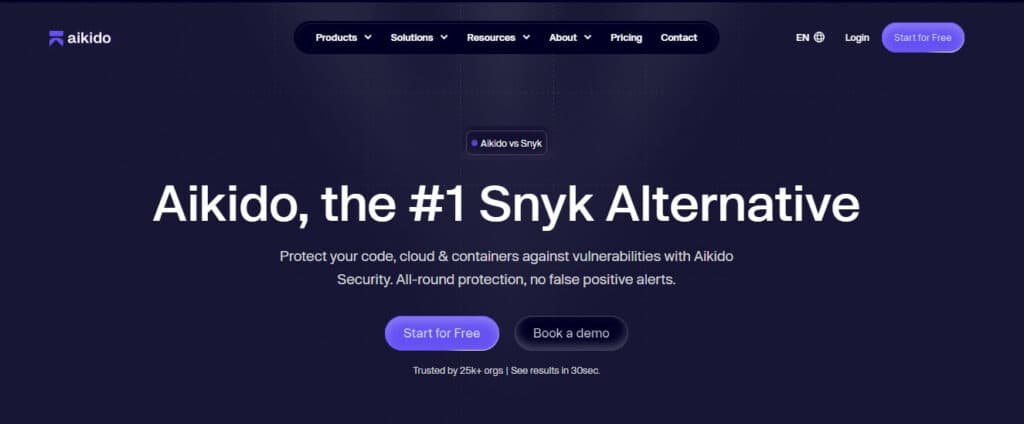
What Aikido consolidates into one platform:
- SAST with multi-file analysis and custom rules
- SCA with reachability analysis across all languages
- Container image scanning with AutoFix for base images
- CSPM with attack path analysis across AWS, Azure, and GCP
- Secrets detection in code and dependencies
- DAST and API security scanning
- License compliance and SBOM generation
- IaC scanning for Terraform, CloudFormation, Helm
Prove’s security team described the old setup as a “Frankenstein” system. Overlapping alerts across multiple tools made prioritization difficult. Security engineers spent time correlating findings instead of fixing them.
The security team at Prove stopped juggling six dashboards. Aikido showed them everything in one place. Vulnerabilities connected directly to code lines, so developers fixed them faster. One security leader said Aikido felt like a Porsche. Powerful. No extra parts are slowing it down.
Aikido connects to GitHub, GitLab, Bitbucket, major clouds, VSCode, JetBrains IDEs, CI/CD systems, Jira, and Slack. An AI triage engine catches false positives before developers ever see them. For teams looking for all-in-one Snyk alternatives, Aikido demonstrates that six separate tools can become one platform.
2. Jit.io
Jit packs ten security scanners into one experience. With one click, the platform turns on SAST, SCA, secrets detection, SBOM generation, IaC scanning, CSPM, DAST, Kubernetes scanning, and container scanning.
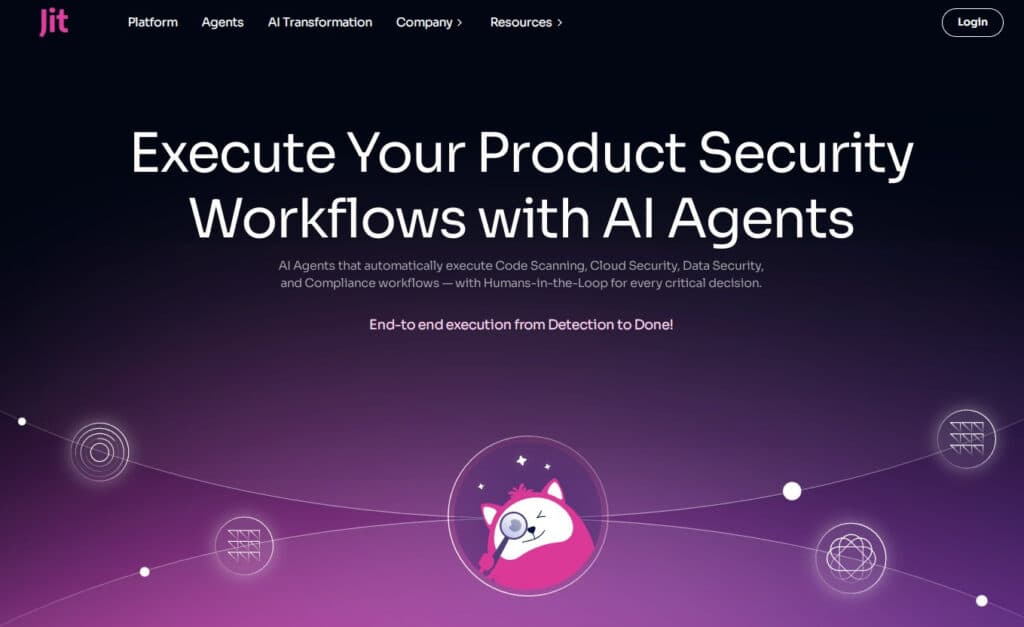
How Jit consolidates security:
- One platform replaces multiple point solutions
- Findings from all scanners appear in a unified, prioritized view
- Context Engine assigns priority scores based on production exposure and internet reachability
- Developers never leave GitHub or GitLab to see security results
- AI agents (Sera and Deva) validate exploitability and suggest fixes
Jit’s Context Engine determines if an issue is exposed to the internet, deployed to production, or calls a sensitive database. Security teams mark critical assets, and the platform filters findings that jeopardize them.
Jit works with GitHub, GitLab, VS Code, AWS, Azure, GCP, Jira, Slack, and Linear. Language support includes Java, JavaScript, TypeScript, Go, Rust, Python, Scala, C#, C, C++, Ruby, PHP, Kotlin, Swift, Terraform, and Kubernetes manifests.
For organizations seeking developer-friendly Snyk alternatives, Jit puts security scans where developers already work. The platform charges one flat rate per developer. That price covers every scanner and all AI features.
3. Black Duck
Black Duck Polaris pulls SAST, SCA, DAST, and AI security scanning into one system. The 2026 releases introduced Signal, an agentic AI scanner built for AI-generated code.

What Black Duck consolidates:
- Rapid Scan Static for AI credential detection (OpenAI, Anthropic, Perplexity, Gemini)
- Full Static Analysis for Java, C++, Go, Scala, .NET 10 with C# 14
- Software Composition Analysis with Deep License Data
- Dynamic Application Security Testing
- Signal agentic AI scanning for AI-generated code
- Infrastructure as Code scanning
- Container security scanning
The platform’s Bridge CLI now imports Signal findings as External Analysis issues. Teams can view AI-generated code security results alongside traditional SAST and SCA findings in one dashboard. Automated remediation pull requests speed up fixes.
Black Duck recently added bulk CI onboarding for GitLab and Bitbucket pipelines. Teams inject Security Scan steps directly into existing pipeline configurations. The guided flow generates pull or merge requests with necessary changes.
License Manager shows every license in use across projects. Terms, organizational fields, and usage data all sit in one view. Deep License Data provides evidence-backed insights at global, application, and project levels.
For teams comparing top security firms vs Snyk alternatives, Black Duck stands out in open-source governance and license compliance. Few competitors match that depth. Polaris acts as the central management layer for all AppSec data, including findings from AI-generated code.
4. Prisma Cloud
Palo Alto Networks built Prisma Cloud as a Cloud Native Application Protection Platform (CNAPP). It secures applications, data, and infrastructure from the first line of code to the cloud runtime.

What Prisma Cloud consolidates:
- Cloud Security with CIEM and compliance management
- Workload vulnerability scanning for VMs, containers, and serverless
- Infrastructure as Code misconfiguration detection
- Least-privileged access enforcement
- Runtime security for Kubernetes, serverless, containers, VMs
- Web Application and API Security (WAAS)
- Application Security with supply chain visibility
New updates brought automated VM workload protection. Prisma Cloud spots unprotected VMs in AWS, Azure, and GCP, then installs the Defender agent automatically. Palo Alto’s WildFire malware analysis service now feeds into runtime protection.
Runtime security covers microservices, hosts, containers, and serverless functions throughout the application lifecycle. The platform automatically inventories every API with no extra setup. Teams discover shadow APIs they did not know existed.
The Vulnerability Dashboard shows prioritized vulnerabilities in one place. Code, build, deploy, and runtime phases all appear together. Remediation options include pull requests for vulnerable packages.
For enterprises evaluating all-in-one Snyk alternatives, Prisma Cloud integrates most deeply with cloud providers and Kubernetes. Pricing requires a sales conversation.
5. Tenable
Tenable One is an exposure management platform that unifies vulnerability management across IT infrastructure, cloud workloads, containers, and web applications. The platform serves approximately 44,000 customers globally.
What Tenable consolidates:
- Vulnerability assessment across traditional and cloud infrastructure
- Cloud security posture management (CNAPP)
- Container image scanning
- Web application scanning
- Identity and entitlement management (CIEM)
- Attack surface discovery and exposure validation
Recent enhancements added graph-based multi-cloud exploration. Teams can query across objects using granular filters and visualize asset relationships and blast radius through an interactive graph view.
An external network scanner validates real-world exposure by probing environments to confirm reachability. This eliminates false positives from static cloud configuration analysis.
Tenable now unifies entitlement tracking across AWS, Azure, GCP, Microsoft Entra ID, and Google Workspace. The inventory view displays all roles and identity-based policies, including those not currently active. Custom security policies can be defined for any role category.
The newly launched Tenable One AI Exposure provides unified AI protection across SaaS platforms, cloud services, APIs, and agents. The platform continuously discovers sanctioned and shadow AI across internal, cloud, and external environments.
The True Cost of Tool Sprawl
Each additional security tool adds more than a line item to the budget. Security engineers spend time correlating findings across platforms. Developers learn different remediation workflows for each tool. Leadership struggles to assemble a complete risk picture from fragmented reports.
Prove experienced this firsthand. Six separate AppSec tools meant six dashboards, six alerting systems, and six places to check for vulnerabilities. The security team described it as a “Frankenstein” system.
Aikido consolidated all six into one platform. The result was simpler: one view of application security risk, one prioritization system, and one remediation workflow.
How to Evaluate All-in-One Platforms
Three questions separate real consolidation from marketing claims.
- First, what does the platform actually cover? SAST, SCA, CSPM, container scanning, secrets detection, and DAST. Missing any of these means keeping another tool.
- Second, what connects without custom work? GitHub, GitLab, Jira, Slack, cloud providers, and IDEs. If those need custom scripts, the sprawl continues.
- Third, how does pricing work? Per-developer fees with module add-ons recreate the same problem inside the budget. Flat fees with all functions included let teams grow without renegotiating every feature.
Final Thoughts
Security teams lose productivity to tool sprawl. Six platforms mean six alert streams, six fix workflows, and six vendor relationships. That math never works in anyone’s favor.
Aikido replaced six separate tools for Prove. Snyk, Checkmarx, and four other AppSec platforms all went away. Faster fixes came with clearer risk visibility.
Jit bundles ten scanners with AI prioritization. Black Duck Polaris combines SAST, SCA, DAST, and AI scanning. Prisma Cloud delivers CNAPP with runtime protection across VMs, containers, and serverless. Tenable One unifies exposure management across infrastructure, cloud, and AI.
Among all-in-one Snyk alternatives to consider, Aikido offers the widest consolidation in one platform. SAST, SCA, container scanning, CSPM, secrets detection, DAST, and runtime protection. All under flat pricing. One platform replaces six tools. One security team replaces multiple vendor relationships. That is how tool sprawl ends.
The Top 5 AI CX Consulting Services That Deliver Personalization & 24/7 Autonomous Support
A security stack grows one tool at a time. First, a SAST scanner. Then, an SCA tool for dependencies. A CSPM platform for cloud misconfigurations. Container scanning. Secrets detection. DAST. Soon, the team manages six dashboards, five vendor contracts, and four different remediation workflows. Each tool makes sense in isolation. Together, they create operational drag. …
Top 5 Foreclosure Lead Tools for Owner Data and Investor Research
A security stack grows one tool at a time. First, a SAST scanner. Then, an SCA tool for dependencies. A CSPM platform for cloud misconfigurations. Container scanning. Secrets detection. DAST. Soon, the team manages six dashboards, five vendor contracts, and four different remediation workflows. Each tool makes sense in isolation. Together, they create operational drag. …